On Painting in Retirement
There's a particular kind of permission that comes with finishing a long working life. The phone stops ringing, the calendar empties, and the afternoon, for the first time in decades, is just an afternoon.
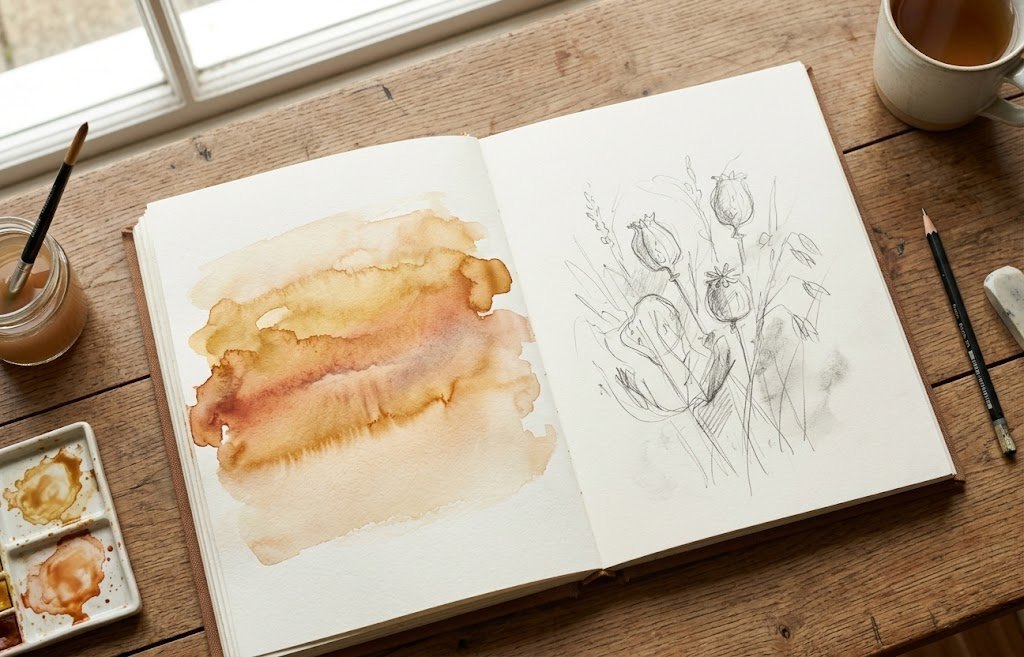
For most of a working life, the day fills itself. There's a job, or a business, or a family — usually all three at once. Time arrives already accounted for. The afternoon doesn't exist as an open question; it exists as a list of things to be done before the evening. Whatever creative impulse a person might have gets fitted into the cracks: a watercolor on a Sunday, a sketch on vacation, a long-imagined book that never quite gets started. There's nothing wrong with this. It's just how the years work when you're inside them.
And then, slowly or suddenly, the structure changes. The phone stops ringing. The calendar empties. There's still plenty to do — there's always plenty to do — but the urgency drains out of it. The afternoon, for the first time in decades, is just an afternoon.
What shows up in the empty hours
This is when something interesting happens, if you let it. The creative impulse that lived for so long in the cracks of the day starts to take up more room. It stops asking permission. It moves in. For some people that's gardening; for others, cooking, or reading, or learning an instrument they wanted to play when they were nineteen. For me it was a small canvas and a few tubes of acrylic paint.
The first paintings were nothing special. Hills, mostly — bands of green and brown stacked under a sky I didn't know how to paint. I tried clouds; they came out wrong. I tried sunlight; it didn't look like sunlight. One afternoon I gave up trying to paint a real sky and just put down a flat color and started making little dots in it with the end of a brush. White dots. Yellow ones. A whole field of them, like pollen or stars or some kind of weather I couldn't name. The painting suddenly came alive. I didn't know why and I didn't try to figure out why. I just kept doing it.
The thing nobody tells you about coming to a creative practice late is that the lateness is part of what makes it good. There's no career to build. There's no point to prove. There's just the work and the afternoon.
What it isn't
I want to be careful about romanticizing this. Painting in retirement isn't some magical second act where you finally become the person you were always meant to be. Mostly it's just learning, slowly, the same things every painter ever learned — that the colors don't behave the way you expect, that the brush you bought online isn't the brush you needed, that the painting you finished yesterday looks completely different in this morning's light. The vocabulary is humbling. The practice is patient.
What is different, I think, is the time. In a life with no more rush left in it, paintings get the time they actually need. There's no client deadline, no portfolio to build, no Instagram algorithm to feed. The piece is finished when it's finished. Some pieces take weeks. Some take an afternoon. Both turn out fine.
What it changes
Painting changes how you look at things. After a few months of paying attention to skies, every drive somewhere becomes a study. The hour before sunset is suddenly different from the hour after. The way light hits a particular hill on a particular day is no longer something you walk past — it's something you store. Six months in, you're not looking at the world; you're cataloging it.
I think this is what older painters mean when they talk about the practice "saving" them. It isn't that painting fixes anything that was broken. It's that painting gives the days a thing to be about. The afternoons are no longer empty; they're either at-the-easel or thinking-about-the-easel or at-the-store-buying-more-cadmium-yellow. The old categories of busy and not-busy stop applying. There's a third category: painting. And it's enough.
For people considering this
If you're somewhere near the end of one chapter and wondering what the next one might look like, here's what I'll say: pick the small thing. Buy the cheap paints. Don't take the class yet. Don't read the books yet. Don't follow the famous painters on Instagram yet. Just start. The mistakes you make in the first six months are the most useful thing you'll ever do — they tell you what you actually want to paint, what you actually love, what kind of painter you'll become.
Mine turned out to be hills and dotted skies. Yours will be something else. The only way to find out is to start putting paint on something.
The afternoons are waiting.
If a piece speaks to you.
Reach out about a specific painting, commission a piece, or just say hello. The studio replies personally.
Get in touch →