Why I Paint Hills
The hills came first; the dots came second. The hills are the part I know how to make. The dots are the part that came out of nowhere and changed everything.
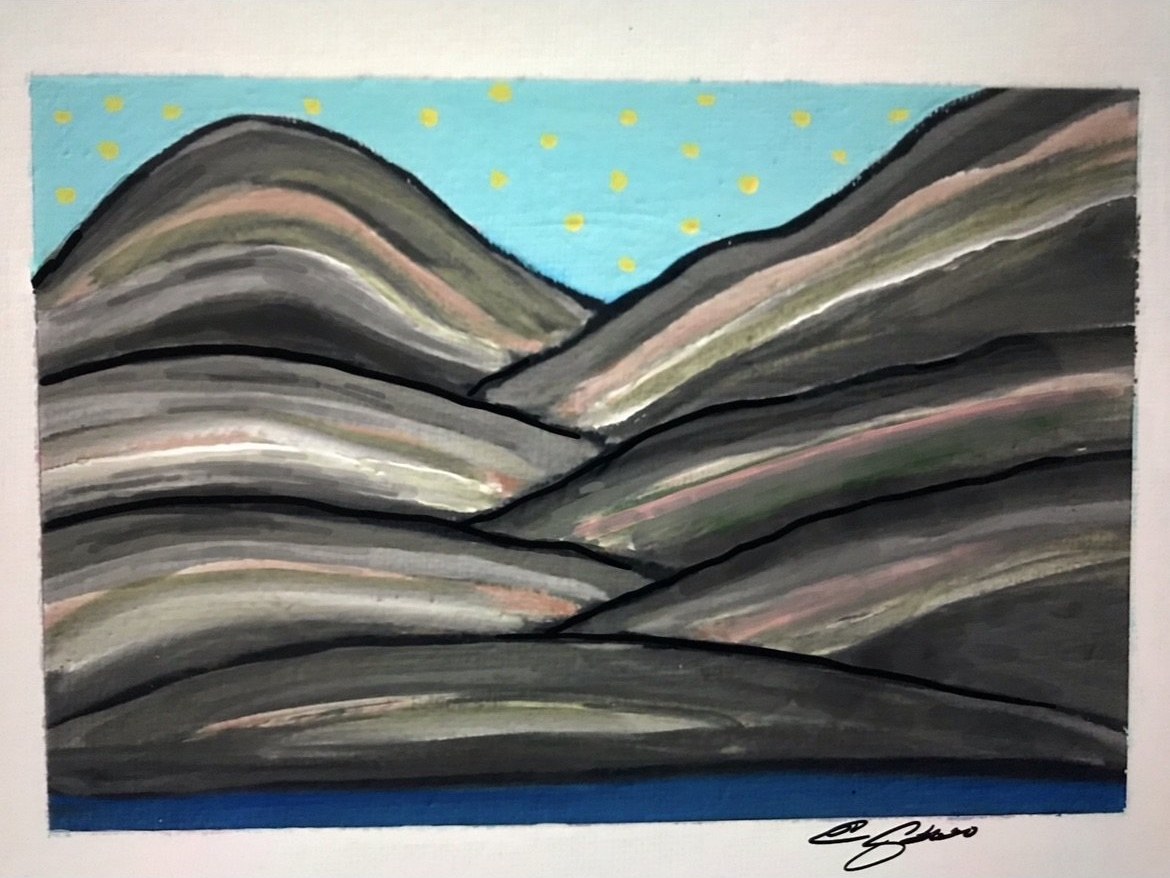
People ask about the hills. They ask less often about the dots, but the dots are really what they want to know about. The hills came first; the dots came second. The hills are the part of the painting I know how to make. The dots are the part that came out of nowhere and changed everything.
Let me tell you about the dots.
What the dots are
The dots are small painted circles — usually yellow, sometimes white, occasionally other colors — that live in the upper portion of a Long Light painting. There are anywhere from a dozen to a hundred of them per piece. They're hand-painted with the end of a brush or a small palette knife. They're not stenciled, not stamped, not applied. They're individual marks placed individually.
People ask: are they stars? Are they suns? Are they snow, pollen, fireflies, weather? The honest answer is: yes, all of those, depending on the painting and the day I painted it. They're whatever the painting needs them to be. In a piece with a deep blue sky, they read as stars. In a piece with a yellow sky, they read as something more like sunlight you can almost see — bright spots in a bright field. In an autumn piece, they almost feel like leaves caught between branches.
The dots are the part of the sky I can't quite explain. They came one afternoon and never really left.
How they happened
The first dotted painting wasn't planned. I was working on a hill piece — three layered hills, a sky, the usual rhythm — and the sky wasn't doing anything. I'd tried clouds. I'd tried a sun. I'd tried the kind of feathered cloud-streak you get in a real summer afternoon. None of it was working. The sky was a flat band of color and the painting felt unfinished.
Out of frustration more than inspiration, I picked up a small brush, dipped it in white paint, and started putting dots in the sky. Tiny ones. Maybe twenty of them, scattered. Then I stepped back, and the painting was alive. The dots had done what the cloud and the sun couldn't: they'd given the sky a rhythm without telling it what to be. The sky stopped being a flat band of color and started being weather.
The next painting got dots, too. And the one after that. Within a few months, the dots had become a part of how I painted skies. Within a year, they'd become a kind of signature — the thing that made a Long Light Studio painting recognizable from across a room. They've since become the thing people email me about most often.
Why hills, though
The hills are simpler. I paint hills because hills are how I see landscapes. When I'm driving through Monmouth County, or up to the Catskills, or anywhere in the American Northeast, what registers is layers. A near hill, a middle hill, a far hill. The water at the bottom, when there's water. The sky at the top. The world arranges itself in horizontal bands, and the bands are the painting.
I'm not interested in painting hills realistically. I don't want to capture a specific place — there are photographs for that, and most of them are better than my paintings. What I want is to paint the rhythm of how a landscape works. The way one band of color sits next to another band of color. The way a hand-drawn line between them is different from a photographic edge. The way you can leave the boundary slightly uneven and the painting feels more alive than if you'd made it precise.
This is, I'm told, descended from a long American tradition of folk-style landscape painting. The Hudson River School ancestors with the loud, sprawling realistic landscapes — and then a hundred years later, the modernist response that simplified everything into shapes and bands. I didn't grow up studying any of that. I just grew up looking at hills, and when I started painting them, the hills came out as bands. It turns out there are a lot of painters who came to the same place from a lot of different directions. That's comforting, in a way. It means the thing I'm doing is real.
What I'm chasing
Every painter is chasing something. Some are chasing accuracy. Some are chasing emotion. Some are chasing technique, or status, or attention, or money. I'm chasing a particular feeling that I can recognize but can't quite describe — the feeling of looking at a hill at the wrong time of day and feeling, briefly, that the hill is looking back at you.
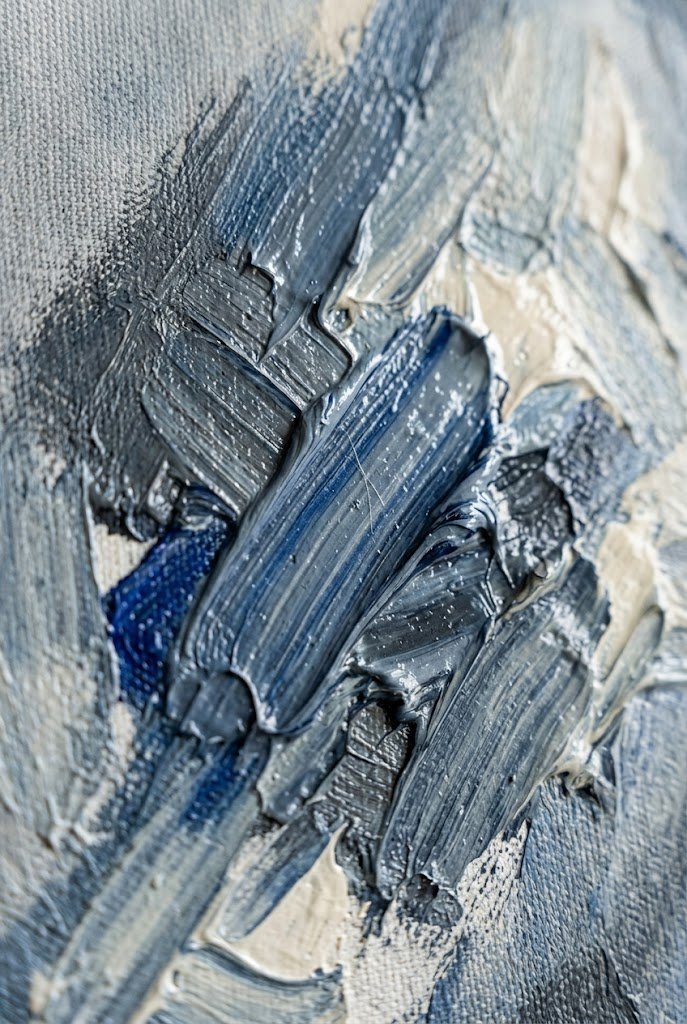
The dotted skies help. The hand-drawn boundaries help. The unpainted edges of the canvas, which I've started leaving visible in many pieces, help. They all do the same job: they make the painting look made. They make it impossible to mistake for a reproduction or a print. They make it visible that a person sat in a quiet room and put paint on canvas in a particular order.
That's the feeling I'm after. A painting that looks painted, by a person, in a quiet room, on an unhurried afternoon. The hills are the way I get there. The dots are the part I never planned.
If a piece speaks to you.
Reach out about a specific painting, commission a piece, or just say hello. The studio replies personally.
Get in touch →